
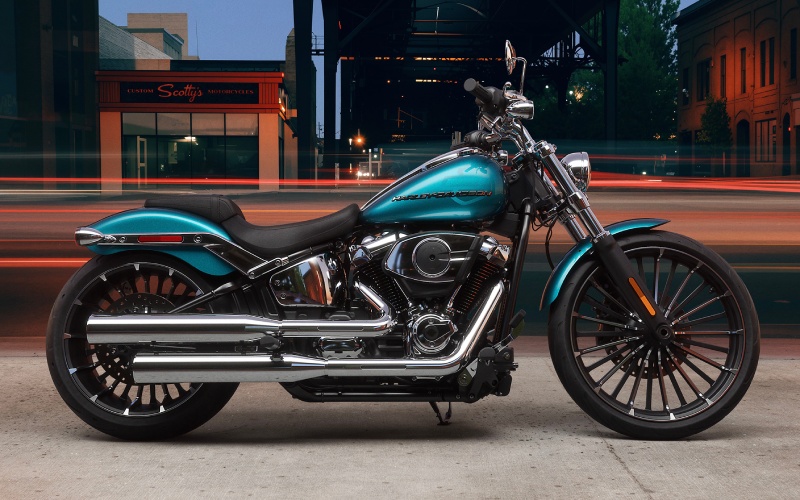
Electric City Harley-Davidson® - Which bike offers easier low-speed control for Mountain Top, PA, riders — the 2026 Harley-Davidson® Breakout® or the 2026 Ducati Diavel V4?
For many riders, the most common question when comparing these two muscle cruisers is surprisingly practical: which motorcycle feels easier to manage at low speeds in town, tight parking lots, and on uneven surfaces? When you line up the 2026 Harley-Davidson® Breakout® beside the 2026 Ducati Diavel V4 and look closely at seat height, power delivery, and driveline character, a pattern emerges. Low-speed control is less about headline horsepower and more about approachable geometry, a predictable throttle, and how the bike sets you up to put a foot down with confidence.
The Breakout’s laden seat height of 25.6 inches makes an immediate difference. Shorter inseams can flat-foot, and taller riders enjoy extra knee bend, both of which ease balance and slow-speed maneuvers. Pair that with 126 ft-lbs of torque at just 3,000 rpm, and you get a forgiving, low-rpm surge that responds without drama. The belt final drive delivers smooth take-up and minimal lash, which keeps parking-lot turns and U-turns composed. By contrast, the Diavel V4’s seat height is 31.1 inches, its power arrives higher in the rev range, and its chain final adds a touch of mechanical crispness that feels great at pace, but can be a bit “busier” at crawl speeds. Both machines benefit from modern rider aids, but the Breakout’s relaxed chassis and torque-first tuning offer a calmer rhythm for urban threading and neighborhood riding.
Ergonomics that build confidence
At walking pace, leverage and body position matter. The Breakout’s wide bars and forward controls complement the long 34-degree rake and 21-inch front wheel. That geometry helps the front end track reliably when the surface is crowned, patched, or gritty. The Diavel V4’s sportier stance and steeper 26-degree rake favor quick direction changes once you’re rolling, but at parking-lot speeds the Breakout’s stretched silhouette often feels a touch more settled. If your daily rides route through tight driveways, angled curb cuts, or brief gravel patches, that stability can be a quiet game-changer.
Another subtle helper is the Breakout’s analog-digital 4-inch gauge. By keeping the primary speed readout analog, you get a quick glance at key info while negotiating traffic gaps, with digital detail available when you need it. The Diavel’s 5-inch TFT is superbly informative, but some riders prefer the Breakout’s minimal glance time in city flow. Both bikes offer ride modes, which you can tailor for gentler throttle response around Mountain Top, PA’s downtown, or when navigating weekend crowds near trailheads and diners.
Torque delivery and driveline feel
Low-speed control thrives on usable torque at low rpm. The Milwaukee-Eight® 117 Custom serves that in spades, letting you short-shift and tractor along without clutch juggling. Belt final drive adds a measured, smooth response that feels almost elastic compared with a chain. The Diavel V4’s 1,158 cc engine is brilliant, especially higher in the tach, but that strength is best enjoyed when you have space to let it sing.
Rider aids provide a safety net on both. The Breakout brings ABS, TCS, DSCS, and cornering enhancements, plus TPMS, to help stabilize traction during imperfect inputs. The Diavel counters with Cornering ABS, Ducati Traction Control, Ducati Wheelie Control, and Ducati Power Launch. For creeping through tight lots, the Breakout’s calibration emphasizes steady, predictable transitions, something riders appreciate when backing into a sloped spot or executing a downhill turn with a full fuel load.
Practical details that matter every day
Small details add up. The Breakout’s 5.75-inch LED headlamp focuses a clean, bright beam for night alleyways and rural intersections, and the USB-C port makes device power trivial when you need navigation on the move. The Diavel V4 leans into cockpit tech with a 5-inch TFT, cruise control, and Hands-Free convenience for key management. If your riding skews toward local errands, short hops between neighborhoods, and scenic connectors, favoring chassis poise at 5 to 25 mph is a smart lens for the decision.
So, which one truly feels easier at low speeds? If you prize a low seat, torque that’s right there off idle, and a driveline that stays calm when you feather the clutch, the Breakout has the edge. Riders who want a taut, sport-forward response will love how the Diavel comes alive as pace builds, but for measured, everyday control, the Harley-Davidson® solution makes the routine feel refined.
Frequently Asked Questions:
Does the Breakout’s low seat change how tall riders feel at slow speeds?
Yes. A 25.6-inch seat provides extra knee bend and lets taller riders use leg strength to stabilize the bike. That leverage is helpful for angled stops, or off-camber turns, where you want sure footing with minimal lean.
How do ride modes affect low-speed behavior on both bikes?
Gentler ride modes soften initial throttle response and can reduce abruptness when slipping the clutch. On the Breakout, that meshes with the torquey V-twin to create an almost “set-and-stroll” feel through town. The Diavel’s modes are excellent too, especially when you want to dial back the V4’s urgency in traffic.
What’s the everyday benefit of a belt final drive vs a chain at low speed?
Belts are quiet, require less routine upkeep, and transmit power with a smooth, progressive feel that’s friendly below 20 mph. Chains offer direct, sporty response and are great at pace, but they add a bit of feedback that some riders notice while maneuvering at a crawl.
Is the Breakout’s 21-inch front wheel a drawback at parking-lot speeds?
No. While a larger front wheel changes steering geometry, the Breakout’s chassis and long wheelbase are tuned for stability. Combined with its low seat and wide bars, most riders find it steady and predictable at low speed.
If you’re weighing these two for daily control and comfort around town, the 2026 Harley-Davidson® Breakout® has the traits that make short trips smooth and unrushed. Electric City Harley-Davidson® is serving Wilkes-Barre, Williamsport, and Mountain Top with insights that focus on how each bike behaves where you actually ride most. Bringing that perspective to your choice often makes the difference between a cool purchase and a long-term favorite.